Health care in America is broken. But one thing we can fix, this November, is ensuring that Denver Health has the resources it needs to serve the Front Range for years to come.
Endorsements
Denver voters can reject two misguided ballot measures and send a strong message to animal welfare advocates that Colorado will not bully our ranchers and hat makers out of business.
Endorsements
David Fitzsimmons, The Arizona Daily Star Pat Bagley, The Salt Lake Tribune
CartoonsColorado needs nuclear energy to address emissions cost-effectively Re: “Is nuclear power becoming cool in Colorado?” Oct. 13 news story Judith Kohler’s October 13 article, “Is nuclear power becoming cool in Colorado?” highlights an important moment for our state. As Colorado transitions away from coal, […]
LettersRe: “Is nuclear power becoming cool in Colorado?” Oct. 13 news story
Judith Kohler’s October 13 article, “Is nuclear power becoming cool in Colorado?” highlights an important moment for our state. As Colorado transitions away from coal, it’s time to recognize that nuclear power is essential to providing clean, 24/7, reliable and affordable power to our state.
Small modular reactors (SMRs) now under review by the Nuclear Regulatory Commission (NRC) use passive safety systems that can cool themselves without human intervention or external power, making them safer. Their compact, factory-built design shortens construction times, limits financing risk, and lowers overall costs — the very issues that plagued earlier plants like Fort St. Vrain.
While wind and solar should be a part of the clean energy mix, we need to be careful about becoming like California, which currently generates 57% from renewables, but has energy prices 40-50% above the national average, and still must import 20-30% of its power from neighboring states.
Contrary to Dennis Wamsted’s assertions in the article, advanced nuclear energy is no longer “on paper.” Both China and Russia have operating SMRs and more in the pipeline. The NRC has formally licensed two of NuScale’s designs, and is reviewing a number of others on an expedited timeline. TerraPower (led by Bill Gates) has broken ground on an SMR in Wyoming and is exploring additional sites in Utah. Kairos has started construction on a reactor in Tennessee. This is all happening now, and Colorado should be a part of this next generation of nuclear energy.
Melinda Alankar, Littleton
Taxpayers in Pueblo’s School District 49, and across Colorado, should be alarmed by the newly announced partnership between an Education ReEnvisioned Board of Cooperative Educational Services and Riverstone Academy, which proudly identifies itself as Colorado’s first “Christian” public elementary school.
At first glance, the arrangement may sound like an innovative approach to education. But peel back the layers, and a far more troubling picture emerges. Public funds — your tax dollars — are now being funneled into a school that explicitly identifies with a religious denomination. That’s not “choice.” That’s an erosion of the constitutional wall separating church and state — one that protects both religion and government from dangerous entanglement.
Even more disturbing, District 49’s own superintendent, Peter Hilts, recently admitted during a public board meeting that fees charged to families are treated as district “revenue” and can be spent “wherever” leadership decides. When taxpayer and parent money can be redirected at will — and when public funds are used to advance religious education — the potential for abuse skyrockets.
This isn’t about faith. It’s about accountability and the rule of law. The Espinoza v. Montana Department of Revenue case cited to justify this partnership does not give public entities carte blanche to fund religion. Colorado’s Constitution is crystal clear: no public money shall aid any church or sectarian purpose.
If this precedent stands, Colorado will have opened the door to publicly funded religious governance, the very danger our founders warned against.
Ryan A Brown, Colorado Springs
Sign up for Sound Off to get a weekly roundup of our columns, editorials and more.
To send a letter to the editor about this article, submit online or check out our guidelines for how to submit by email or mail.
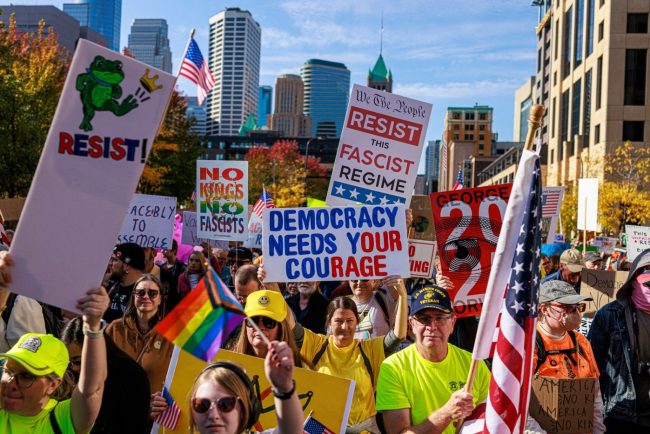
By the time you read this another round of “No Kings” protests will have taken place across Colorado and the country. Participants will feel empowered from standing shoulder to shoulder in solidarity chanting slogans and waving signs their voices of dissent heard loud and clear […]
ColumnistsBy the time you read this another round of “No Kings” protests will have taken place across Colorado and the country. Participants will feel empowered from standing shoulder to shoulder in solidarity chanting slogans and waving signs their voices of dissent heard loud and clear coast to coast.
But now that the signs are propped against the garage wall and social media feeds feature more dog videos and advertisements than protest pics, it’s worth asking: what did the “No Kings” protest accomplish? Was the message heard by anyone other than those making it? Did it change a single mind?
Probably not. The fact that I had to look up what organizers meant by “No Kings” is one indication. With the dozens of well-funded left-leaning organizations listed as partners on the website, surely one of them could have the lent the effort a descent comms guy. For all its catchy repetition, the website’s declaration “No Thrones. No Crowns. No Kings” makes no sense. These don’t exist even in Trump’s garishly gilded Oval Office. The “about” page, which goes on about tyranny, dictatorship, and coronation, is no less illuminating. What country are we talking about?
This is the kind of overwrought language that even sympathetic readers like me find laughable. And I am sympathetic. President Trump is mendacious, vengeful, and unscrupulous. He continuously violates constitutional boundaries by violating due process and usurping the legislature’s prerogatives. He elevates unqualified sycophants to head agencies, alienates foreign allies, and uses government power to punish opponents. Also, his tariffs are driving up prices. But he isn’t the first to abuse power in these ways (though he may be the most brazen) and the courts are restraining his worst excesses. The republic remains strong.
Trump is no king, much less a dictator or a tyrant. Words like these should be reserved for men like Russia’s Putin and Venezuela’s Maduro if they are to mean anything. Trump critics have to find better ways to communicate our concerns. Fear-mongering, which comes off equal parts paranoid and patronizing, is the surest way to make people stop listening.
In the past, I’ve found that the best way to be heard is to first listen. I’ve asked thoughtful, Trump supporting friends why they like the president. They told me that they support his policies to secure the border, increase energy production, tackle government waste, protect women’s sports, uphold religious liberty, and increase school choice. One friend said, although she doesn’t always like what Trump says, she appreciates that he says what he thinks instead of mincing words. Another said she likes his efforts to ease regulatory burdens and his work ending the Hamas-Israel conflict.
The last point is something everyone, right or left, can agree is an unqualified good. War is tragic. The ceasefire and return of the hostages is a foreign policy triumph that could be a first step toward lasting peace between Israelis and Palestinians. By acknowledging Trump’s positive role, Trump critics can create common ground for dialogue with Trump supporters. We can earn the right to have our concerns heard.
Alas, “Trump deserves praise for facilitating peace in Israel and Palestine but we have grave concerns about several of his domestic policies” doesn’t fit well on a protest sign, but it’s more likely to be heard by Trump supporters. Conversing with the unconverted is much harder than preaching to the choir.
Krista Kafer is a Sunday Denver Post columnist.
Sign up for Sound Off to get a weekly roundup of our columns, editorials and more.
To send a letter to the editor about this article, submit online or check out our guidelines for how to submit by email or mail.

The Lower Basin is doing our part for the Colorado River Re: “California and Arizona’s water negotiators wrong to target Colorado,” Oct. 12 editorial The editorial misrepresented both facts and intent. In a perfect encapsulation of the us-vs-them mentality pervading the Colorado River Basin, my […]
LettersRe: “California and Arizona’s water negotiators wrong to target Colorado,” Oct. 12 editorial
The editorial misrepresented both facts and intent.
In a perfect encapsulation of the us-vs-them mentality pervading the Colorado River Basin, my recent quote in the Los Angeles Times calling for all of the Basin States to abandon legal hardlines for a compromise solution was reinterpreted by the Post’s Editorial Board as “over-the-top hyperbole” and “accus[ing] the upper basin states of Wyoming, Colorado, Utah, and New Mexico of clinging to ‘their most aggressive and rigid dreamland legal positions.’”
As tempting as it is to look outward rather than inward for the solution to dwindling runoff and storage in the Colorado River Basin, that approach leads only to failure.
California, Arizona, and Nevada (the Lower Basin States) have not been sitting idly by in the face of this historic drought. Over the past two decades, collective Lower Basin actions have raised the elevation of Lake Mead by nearly 190 feet. From 2023 through the end of 2026, we are projected to cut water use by a staggering 7.5 million acre-feet, more than double the Upper Basin’s annual use.
Going forward, we have proposed annual cuts to the Lower Basin that dwarf current commitments, with those reductions expanding to the Upper Basin only if hydrology worsens. In all the proposals discussed so far, the Lower Basin has offered to take on 85% or more of the needed cuts.
Lower Basin representatives are also acting to protect the farms and families we represent, who make up three-quarters of the Basin’s residents. We cannot accept a solution in which the Upper Basin does not meaningfully participate.
We are running out of time. New Colorado River rules must be adopted before 2026. The key issue is how all seven Basin States will share in the cuts necessary to live with less water.
Scapegoating downstream may feel satisfying, but it solves nothing. The only way forward is through compromise and cooperation — not falsehoods and finger-pointing.
JB Hamby, El Centro, Calif.
Editor’s note: Hamby is Chairman of the Colorado River Board of California.
Re: “Fighting Colorado for the free speech I need and my clients deserve in my office,” Oct. 12 commentary
In her commentary, Christian counselor Kaley Chiles wrote, “My calling is simple: to listen with compassion to my clients and to walk with them through their struggles.” But, as she rightly contends, the State of Colorado has passed a law legally forbidding her to help her clients.
There was a time when Chiles would have been commended for her service. To its credit, the U.S. Supreme Court agreed to hear her case.
In Colorado, Christian proprietors have been repeatedly targeted for exercising their free exercise of religion. Why then should it be surprising that Chiles has been targeted for refusing to “parrot a government-approved viewpoint” that inveighs against her religious beliefs? Isn’t it the Christian faith, after all, that is under siege in Colorado?
Brian Stuckey, Denver
Re: “Conversion therapy: Justices seem skeptical of ban in Colorado case,” Oct. 8 news story
The Supreme Court oral arguments focused a lot on the free speech of the therapist versus the harm done to the youth client. I am an 83-year-old gay man, who got married and had two children before I came out at 43 to overcome my severe depression. I had been programmed by my Catholic priest confessor to deny my sexuality so that I even believed it myself.
The free speech argument supposes that it is a friendly conversation between two more or less equal people, not the situation of a confused, afraid adolescent and a trained, verbally adroit adult. That is on top of a social context that is strongly biased — or the parents wouldn’t be bringing their child to the therapist in the first place. The free speech argument stinks.
John D. Ferguson, Denver
Re: “EPA’s roll back of greenhouse gas finding will only endanger communities like mine in Adams County,” Oct. 12 commentary
Your urging to the Environmental Protection Aagency is no better than standing at the grave of your favorite scientist and urging them to awake! Science began falling prey to political appointees in the early 2000’s, when the division between the two political parties began to heat up to the melting point we see today.
The science that protects us from the cancer we may get 30 years later is fragile and easily upended by political appointees’ non-caring decisions. Ignoring simple science leaves us asking when will the next major waterborne disease outbreaks occur like in Gideon, Missouri, and Alamosa, Colorado? People died in both cases.
Ignoring more complex science leaves us with hundreds of years of neurologic damage to our children by leaving lead pipe in the ground. The EPA is aggressively ignoring the apex of scientific complexity: climate change, which involves all fields of science and is an existential threat to people we will never meet. Political appointees are actively quashing and eliminating these experts. Putting this in perspective, political appointees are performing the last body slam to an almost dead body of science at EPA. We might as well be asking Sauron (Lord of the Rings) for peace. They have abandoned empathy for power.
Robert Clement, Littleton
Re: “Man is a scientific unicorn who’s dodging Alzheimer’s,” Oct. 12 news story
Thank you to Doug Whitney and others like him who volunteer to be studied for years and submit to physical tests. He is helping and giving and I thank God that he is willing. He is also a Naval veteran. A hero in so many areas.
Deanna R Walworth, Brighton
Re: “Homecoming celebrations turn deadly; eight are killed in separate shootings,” Oct. 12 news story
Trump claims to be the president who advocates for law and order. But an article published in The Denver Post: “Homecoming celebrations turn deadly, eight are killed in separate shootings” covered that in Mississippi, on separate sides of the state, high school homecoming celebrations ended in gunfire with at least eight people dead, including one pregnant woman, twenty more wounded and four in critical condition being flown to hospitals.
Sure sounds like a situation for Trump to call in the National Guard and maybe the military to quell the violence. But wait, this is Mississippi, a state that supported him and everyone knows violence and lawlessness only occur in cities like Chicago, Washington D.C. and Portland, Oregon, cities that did not support him. Apparently, when Trump took his oath of office, he did not understand it included all Americans and all states. He seems to feel he has right to seek revenge on all who did not support him, even though they are probably the majority.
Steve Nash, Centennial
Re: “Penner talks early stages of stadium design,” Oct. 11 sports story
In October of 1964, I caught my first live Bronco game sitting in the temporary east stands at the old Bears Stadium. It was my first and coach Jack Faulkner’s last – the fans rolled out a large ‘Hit the Road, Jack’ sign in the second half as we were losing again – and I fell in love with the team. Been through a couple stadium moves since and hope to see the first game at Burnham Yards before I wing it. My request to ownership is don’t dawdle. I’ll be 91 in 2031, and I fear my beer is going flat.
Harry Puncec, Lakewood
Re: “Audit: Police oversight office does too much work in secret,” Sept. 23 news story
The role of the Office of the Independent Monitor is difficult and often misunderstood. Unfortunately, headlines and articles like the Denver Post’s, “Denver’s police oversight office does too much work in secret, audit finds,” do little to improve public understanding of the complex legal environment the OIM operates in or the challenges they have already overcome in building a nationally recognized oversight model.
The Citizen Oversight Board was established to serve as an independent body charged with evaluating the effectiveness of the Office of the Independent Monitor (OIM). With access to the confidential materials the OIM handles, we conduct rigorous assessments and publish our findings in annual reports. We take this responsibility seriously and consistently urge the OIM to leverage every available resource to deliver updates that are accessible, relevant, and informative to the public.
Over the past two decades, the ordinances guiding the Office of the Independent Monitor (OIM) have been revised multiple times to strengthen its capacity to serve the public effectively. We welcome the opportunity this audit report presents to evaluate whether additional changes to the ordinance are warranted.
However, sensationalized headlines do little to advance meaningful reform. They undermine the progress Denver has made in building a robust oversight framework and fail to foster a deeper public understanding of the complex environment in which the OIM operates.
Julia Richman, Denver
Editor’s note: Richman is chairman of Denver’s Citizen Oversight Board, which oversees the Office of the Independent Monitor.
Right-wing sources claimed that members of “Antifa” were in the crowd that stormed the Capitol on January 6. Since then, over 1,200 people have been arrested and charged for their part in the insurrection including The Proud Boys and the Oath Keepers but no one identified as “Antifa” was arrested. Was this because it was a left-wing conspiracy, or were MAGA folks looking for a Yeti?
Over the past 4+ years, no “Antifa” sightings have occurred – no FBI or ICE arrests, no word about their leaders; their organization, their funding, their internal communications, their secret handshake, etc.
Now the babble about them is back.
Like a Yeti, when the first Antifa member is caught and confesses, let’s have a press event and expose the “entire” structure of the organization.
Until then, common sense says we are chasing a Yeti …
Curt Anderson, Broomfield
Sign up for Sound Off to get a weekly roundup of our columns, editorials and more.
To send a letter to the editor about this article, submit online or check out our guidelines for how to submit by email or mail.

Matthew Silverstone, at the young age of 18, has sacrificed more for Colorado than most can imagine. The teen first warned his fellow students at Evergreen High School that there was a shooter on campus, then he confronted the shooter on the street outside the […]
OpinionMatthew Silverstone, at the young age of 18, has sacrificed more for Colorado than most can imagine.
The teen first warned his fellow students at Evergreen High School that there was a shooter on campus, then he confronted the shooter on the street outside the high school. Silverstone was shot twice.
He spent a month in a Lakewood hospital fighting for his life and then recovering from the wounds that almost killed him. He was released from the hospital Tuesday in what his family called a miracle, and we call a blessing.
“Matthew has never given up. He can now speak. In fact, he is happy to tell you, ‘I’m still alive!’ He can walk with assistance,” his family said in a news release. “His friends will tell you his sense of humor is back. He has exceeded everyone’s expectations in his recovery.”
Silverstone was both brave and selfless on Sept. 10, and it sounds like he continues to shine through his recovery, giving everyone hope in these dark times.
Silverstone is not alone in his distinction as a true Colorado hero.
Another student who was shot at Evergreen High School last month confronted the shooter. At the age of 14, the victim’s family has understandably chosen to remain anonymous and keep out of the public eye. We wish to respect their privacy while also highlighting the incredible act.
Both students remind us of Kendrick Castillo, who was killed defending his classmates inside a Highlands Ranch school in 2019. Castillo was joined by other classmates — Brendan Bialy and Joshua Jones — as they lunged at a shooter, saving others. Bialy was not hurt, but Jones was shot twice.
We are torn between celebrating these incredible acts and crying for the state of our country. Mass shootings have been occurring in Colorado schools since the 1999 Columbine High School massacre. How is it that students are still the ones confronting these assailants and not our trained adult professionals in law enforcement? Every school in this state needs an armed officer on campus at all times.
We should not be asking our kids to save themselves. More must be done to protect students who attend school hoping to grow and learn, and far too often in the past decade have found themselves trying to survive the horrors of mass shootings and the trauma that follows.
Nine minutes passed between when the shooting began inside Evergreen High School and when Silverstone was shot at the corner of Buffalo Park Road and Olive Road at the far end of the high school’s campus. Having an officer on the campus could have resulted in a different outcome.
Expressing gratitude to these kids for their acts of heroism is not enough. We can name a street for Silverstone (and should, just as we created Castillo Way). We can cry for their pain and suffering, and rejoice at their perseverance and determination.
But adults in Colorado must now act to ensure that no other child in this state is forced to fight an armed assailant for their lives and the lives of their friends and teachers.
Sign up for Sound Off to get a weekly roundup of our columns, editorials and more.
To send a letter to the editor about this article, submit online or check out our guidelines for how to submit by email or mail.

Updated 2:10 p.m. Oct. 17, 2025: Due to an editor’s error, this article previously misreported details about the shooting of Matthew Silverstone.
Tragically, in 2019, my fiancée took her own life. What began as one of the most heartbreaking, devastating experiences of my life, turned into an unending nightmare. The police arrested me after I called 911 because they believed we had been arguing. But then, with […]
ColumnistsTragically, in 2019, my fiancée took her own life. What began as one of the most heartbreaking, devastating experiences of my life, turned into an unending nightmare. The police arrested me after I called 911 because they believed we had been arguing. But then, with scant investigation, prosecutors immediately charged me with murder and imprisoned me for 72 days without bail.
A jury eventually found me not guilty, but only after my attorney learned a prosecutor purposefully withheld evidence exonerating me. That may be unimaginable in America — but it happened to me. And when it did, I learned the hard truth: prosecutors (unlike almost any other lawyer or professional) enjoy absolute immunity, meaning both the wrongly accused and victims of crime have no recourse, and prosecutors cannot be sued for the damage they cause.
I learned firsthand that when attorneys fail to fulfill their oaths of office, just like a doctor or police officer, the consequences can be dire – even life-ending. This becomes even more egregious when that failure is purposeful, yet not all attorneys are held equal under the law.
I was wrongly incarcerated and prosecuted, even though the forensic pathologist refused to rule my fiance’s death a homicide. Only weeks after my arrest — while I remained behind bars — Denver’s own chief deputy crime lab director and the lead Denver homicide detective advised the prosecutor of their opinions that the death was not a homicide, but a suicide. Even though the prosecutor knew this critical information that would have exonerated me, the prosecutor purposefully withheld this information from myself and my defense team for nearly 8 months. I was eventually acquitted only after these opinions were forcibly revealed in response to a court order.
Who was that prosecutor? Chief Deputy Dan Cohen from the Denver District Attorney’s office. The judge, clearly outraged, issued a sanction allowing my lawyer to cross-examine the witnesses about their favorable opinions — but otherwise faced no consequences. His law license remained intact, and his boss excused the behavior.
Imagine my outrage and disappointment when I read a recent Denver Post article covering judges dismissing other cases in which Chief Deputy Daniel Cohen failed to disclose critical and favorable evidence to the accused. In the most recent case, this was again not a clerical oversight or an isolated misstep. In fact, the judge in the case ruled, “At this point in time, I can’t find that it’s anything other than willful given the number of times this issue has been addressed with this particular counsel.” The Post article pointed out that there have been at least seven other discovery violations committed by the Denver District Attorney’s Office since February of 2025.
These are real Coloradan’s lives on the line. Yet the wrongly accused, like myself, have no recourse to hold prosecutors accountable.
This story shows that even when judges grow frustrated with prosecutors’ misconduct, their tools are limited. They can allow broader cross-examination or dismiss a case — but they cannot punish the prosecutor. The repeated violations we see prove that these sanctions, while appropriate, do little to deter misconduct. And with Mr. Cohen still abusing his power five years after egregiously breaking the rules in my case, it’s clear the Denver District Attorney’s office isn’t imposing serious discipline either.
Prosecutors are the most powerful lawyers in America. They decide who to criminally charge, when and what crimes to allege, whether to offer leniency, what evidence to turn over and what sentence to pursue. As I now personally understand, they have an immense amount of power to impact the lives and families of both the guilty and the innocent.
Given this power, you’d expect prosecutors to be held to higher standards of accountability. Instead, the opposite is true. Misconduct is brushed off as business as usual, denied and excused at every turn, and much of it never comes to light. Even when caught red-handed, prosecutors keep their jobs and their law licenses, shielded from any liability for damage they cause. In any other profession, mine included as an architect, such deliberate abuses would end a career.
Cohen, like other prosecutors who commit intentional misconduct are shielded – entirely. Like in Cohen’s case, they rarely face employment or bar discipline, and they also can’t be sued for the deliberate harm they cause. I eventually went with my only recourse and filed a lawsuit against the City of Denver and the police force because, unlike prosecutors, they don’t have unlimited immunity. A judge unfortunately dismissed the case, because ultimately it was the (immune) prosecutor, and not the detective, who could be held to answer to a jury for the alleged malicious prosecution and for the willful failure to disclose the favorable evidence.
Many prosecutors do act with integrity. But as this story makes clear, absolute immunity has bred a culture of impunity that leaves them above the very law they’re meant to enforce. But no one should be above the law.
When prosecutors break the rules, justice breaks down. People like myself suffer a potential wrongful conviction. Our careers and families are destroyed, our reputations are ruined, and we suffer crushing financial loss. At the same time victims of crime are denied justice and finality. The result is a system the public can’t trust. If Colorado is serious about restoring trust and protecting the rights of every Coloradan, it must reform the law so prosecutors can finally be held accountable.
Micah Kimball is a licensed architect and general contractor who designs and builds thoughtful spaces. After a prosecution that derailed his career and life, he now works with Protect Ethical Prosecutors to promote fairness and reform.
Sign up for Sound Off to get a weekly roundup of our columns, editorials and more.
To send a letter to the editor about this article, submit online or check out our guidelines for how to submit by email or mail.
No on 310: Protect small businesses in Denver Re: “Bloomberg gives $1.5M to help save flavored-tobacco ban,” Oct. 9 news story As ballots begin arriving in mailboxes, small business owners like me are standing up to a New York billionaire who has poured $1.6 million […]
LettersRe: “Bloomberg gives $1.5M to help save flavored-tobacco ban,” Oct. 9 news story
As ballots begin arriving in mailboxes, small business owners like me are standing up to a New York billionaire who has poured $1.6 million into keeping Denver’s flavored tobacco ban in place. This brings the total to more than $2 million raised to influence the outcome of Referendum 310, funding a wave of misleading ads aimed at confusing voters.
This measure gives Denver voters the opportunity to restore local control and allow the sale of flavored vape products to adults 21 and older. It is not about kids — it is already illegal to sell these products to anyone under 21. What’s really at stake is fairness for responsible small businesses and whether Denver keeps $13 million a year in local revenue that currently funds critical services like preschool, K-12, and public safety.
The No on 310 campaign is powered by Colorado-based small business owners who believe that local decisions should be made by local voters, not out-of-state billionaires. These are family-run stores that have served their communities for years and now find themselves fighting to survive against a massive, well-funded campaign that doesn’t understand our city or our economy.
Voting No on 310 protects small businesses, saves local jobs, and ensures that $13 million stays here in Denver — supporting the schools, safety, and community services we all rely on. This is about standing up for local families, local workers, and the right for responsible adults to make their own decisions.
Kristen Hensel, Denver
Editor’s note: Hensel owns Rusty’s Vape and Smoke Shop.
In reference to ballot measure 310, the vaping ban, one needs to recognize that the addictive qualities of nicotine are only surpassed by cocaine and heroin. So ignore the subterfuge being generated by the tobacco/vaping industry.
The bottom line is that vaped nicotine produces a better revenue profile over time than cigarettes because vaping doesn’t kill off its addicts. Of course, the “industry” wants to get as many people “hooked” on nicotine as they can. Regrettably, many people will be paying for this addiction for their entire lives — much to the delight of the industry.
Please vote “Yes” on 310 to retain the ban on vaping products in Denver.
Guy Wroble, Denver
Re: “Housing crunch: 2 suburbs, 2 paths,” Oct. 5 news story
The zoning issue that is engulfing Lakewood is a clash of ideas about what Lakewood should become. Many see a change to higher density as necessary to make the city vibrant and affordable, while others view density as obliterating the essence of Lakewood, that is, open space and trees — what people moved to Lakewood for.
With the proposed zoning plan, which drastically reduces the sizes of residential lots (to as small as 1,500 square feet), the city council is pitting a population that wants to live in Lakewood and buy an affordable home against people who already live there and bought specifically for larger lots.
In a sense, the new zoning is a taking. An existing homeowner can still do what he wants but he has no control over adjacent properties, the size and density of which were guaranteed when he bought. Also, there is no assurance of affordability once a developer is in the picture, and the city of Lakewood has no accounting of how many affordable units have been built, at least the number has not been made public when asked in council meetings.
The burden of infrastructure — more water taps, sewage lines, and roadways — has not been figured into the densification projection (check out the traffic on Wadsworth Boulevard now).
We are told that the change will be gradual, with no bulldozers showing up en masse on January 1st. Cut to the story of the frog who does not realize he is cooking in the pot that gradually warms to boiling.
C. Greenman, Lakewood
Sign up for Sound Off to get a weekly roundup of our columns, editorials and more.
To send a letter to the editor about this article, submit online or check out our guidelines for how to submit by email or mail.
This summer, a grizzly cub in Grand Teton National Park gained international fame after an adult male bear killed the yearling’s two siblings. The sole survivor of the attack, dubbed “Miracle,” then separated from its mother to fend for itself, sometimes hanging around a busy […]
ColumnistsThis summer, a grizzly cub in Grand Teton National Park gained international fame after an adult male bear killed the yearling’s two siblings. The sole survivor of the attack, dubbed “Miracle,” then separated from its mother to fend for itself, sometimes hanging around a busy area of the park.
As Miracle’s story spread, the cub became the object of fascination for thousands of people. Perhaps that’s no surprise, as many of us are intrigued by the grizzly’s power and strength, along with the reality that it’s an apex predator, like us.
Miracle’s survival is precarious. Since she left the protection of her mother so early, she’s on her own finding food before hibernating. Seventy-seven grizzlies died in the Yellowstone area last year–the highest number yet. As of September 2025, 63 bears had been killed; at this rate, the number of dead bears will surpass last year’s record. What’s going on?
You could say that grizzly bear recovery in the Lower 48 is a success story. Prior to European settlement, an estimated 50,000 bears roamed throughout the Lower 48. By 1970, though, only about 800 remained, with perhaps 130 of them in the Greater Yellowstone Ecosystem.
In 1975, grizzlies were listed under the Endangered Species Act, which ended their indiscriminate slaughter, and bear numbers slowly rebounded. Today, the Forest Service says an estimated 700 grizzlies live in and around the Yellowstone area, with maybe 1,000 more in the Northern Continental Divide region of Montana. Despite the increase in numbers, mortality rates are on the rise.
Most wildlife managers say the current rate is not a matter of concern. They say the species is stable.
And yet, is it? Roughly 200 cubs are born in the Greater Yellowstone Ecosystem recovery area each year, but of those, only around 40 survive. Wildlife managers assure us bears are doing well, but is this sustainable — especially when the mortality rate keeps inching upward year after year?
The most obvious reason for bear deaths is us. We are everywhere. 2024 marked the second-busiest year in Yellowstone National Park’s history with more than 4.7 million visitors. In August of 2025, the park was on track to see a 2% visitor increase over 2024.
On top of increased visitation, the human population in the Rocky Mountain West where grizzlies roam is growing steadily. Teton County, Wyoming has seen a 10% increase in residents over the last decade. The population in Teton County, Idaho is up 74% since 1990. Gallatin County, Montana has grown about 40% in the last 10 years.
On the ground, you can’t miss the impacts of growth: Trails are crowded. Parking is at a premium. You need reservations at restaurants, and the traffic is often stop and go. Not surprisingly, bear-human conflicts are more frequent: Vehicle collisions kill bears, interactions with landowners kill bears.
Grizzlies might do fine with more people if their habitat were intact and healthy, but much of their home ground has been in moderate to severe drought for several years, according to U.S. Drought Monitor. This year’s berry crop was dismal. Whitebark pines, whose seeds are an important food source for bears, are threatened by beetles and blister rust.
All this forces grizzlies to search out new food sources, and some of the best ones turn out to be ours. Our cows and sheep. Our apple trees. Our bee hives.
Wyoming U.S. Representative Harriet Hageman has introduced legislation to take away endangered species protections for grizzly bears, which would be a major blow to their survival. “People shouldn’t have to live in fear of grizzly bears rummaging through their trash or endangering their children,” Hageman said. Such comments are deliberately inflammatory.
I have heard three people describe surviving a bear attack decades ago. All three insisted that the bear was only acting in self-defense. One even remembers how awed he was by the diamond-like glint of water droplets on the bear’s fur as she ran toward him.
I’m not sure what would happen if I faced a charging bear. I just want enough wherewithal to pull out my bear spray. While I hope I never have to deploy that spray, I am willing to take the risk to know wild bears roam the landscape. If grizzlies were gone, something vital would be missing from our world.
While grizzly bear mortality may not yet be alarming wildlife managers, I hope we’ve gotten a wakeup call.
Molly Absolon is a contributor to Writers on the Range, writersontherange.org, an independent nonprofit dedicated to spurring lively conversation about the West. She hikes and writes in Yellowstone bear country.
Sign up for Sound Off to get a weekly roundup of our columns, editorials and more.
To send a letter to the editor about this article, submit online or check out our guidelines for how to submit by email or mail.
Campus action against film screening seems to conflict with spirit of Sundance Re: “Police shut down students’ film screening,” Sept. 27 news story The relocation of the Sundance Film Festival to Boulder is certainly a good thing for the Colorado film community. Much good will […]
LettersRe: “Police shut down students’ film screening,” Sept. 27 news story
The relocation of the Sundance Film Festival to Boulder is certainly a good thing for the Colorado film community. Much good will come from it, including a partnership with the University of Colorado. The recent death of actor Robert Redford casts another element of significance over all of this.
In a way, though, the recent news story about the university’s Boulder campus police shutting down a student group’s screening of a film about a Palestinian family leaves me with a sense of dread over how Boulder will value the freedom of expression through film and within the industry. CU is pointing to some compliance issues with their policies, whereas the student groups feel repression over political content.
There seems to be a direct conflict between Sundance’s arrival and the screening of the film at CU. Issues of freedom of speech, an incident in April on campus, the plight of Palestine and associated protests and safety concerns come together here. But it seems that how Sundance will impact the landscape of film in Colorado is not yet understood, as evidenced by what occurred at CU.
In my mind, Boulder and Colorado should be very clear about their vision, values, and priorities with regard to Sundance, because the global film industry is shining a light on Colorado that will only grow in strength. I hope the community is prepared.
Gary Rauchenecker, Golden
As one who has been part of academic decisions for more than 40 years at some 10 different colleges and universities, I can tell you for a fact there are four things conservatives have never really understood about the ideological makeup of colleges:
• There are relatively few conservatives who go into academia, as the pay and publication pressures are rough for people who need 20 years of formal education and a publishable dissertation. Liberals likely endure all that because they are less motivated by making a lot of money and not as sold on the corporate grind.
• There already is affirmative action for conservatives. Conservative applicants are so few and far between that it already counts as a net plus in most teaching searches, unless it’s obvious they are looking to proselytize, then they are avoided like they would be for leftist firebrands as well.
• Courses will be offered and taught largely the same way, no matter the ideology of the instructor. Most use one of a relatively small number of moderate textbooks. And if students don’t elect to take their courses, they are out. Students get the courses they want.
• The large majority of courses offered at any college or university don’t even touch on ideologically controversial topics.
Marcus D. Pohlmann, Highlands Ranch
Editor’s note: Pohlmann is Professor Emeritus of Rhodes College
Re: “Sheridan RV Park: Residents face losing their homes if city OKs project,” Sept. 27 news story
There it is, Colorado, your long-time rumored “low-income housing.” Come to find out, it’s been here all along. Let’s see what you do about the proposed destruction of it.
Susan Williams, Lakewood
Sign up for Sound Off to get a weekly roundup of our columns, editorials and more.
To send a letter to the editor about this article, submit online or check out our guidelines for how to submit by email or mail.
On Oct. 7, I walked into the U.S. Supreme Court, not because I ever imagined myself there, but because I love the kids and families who sit across from me in my counseling office. I’m a licensed professional counselor in Colorado. My calling is simple: […]
ColumnistsOn Oct. 7, I walked into the U.S. Supreme Court, not because I ever imagined myself there, but because I love the kids and families who sit across from me in my counseling office.
I’m a licensed professional counselor in Colorado. My calling is simple: to listen with compassion to my clients and to walk with them through their struggles. Some of the kids I have met are carrying heavy questions about who they are. They’re confused, hurting, and longing for someone to hear them out. Many just want help making peace with the bodies God gave them.
But Colorado has interfered in those discussions. In 2019, the state passed a law that censors me from saying certain things to my clients. If a teenage girl who started identifying as a boy tells me, “I want to learn to be comfortable in my body and try to live as a girl again,” I am legally forbidden from helping with that goal. Yet if that same child says, “I want to reject my body and continue living as a boy,” the law allows me to encourage that path. The government has picked sides. And if I don’t comply, I risk thousands of dollars in fines, suspension, and even the loss of my license.
That reality is devastating to me, because the very reason I became a counselor was to create a safe space where people could be honest, share their deepest questions, and sort through their struggles without fear of judgment. Counseling isn’t about pushing an agenda; it’s about offering the care a client is asking for. It’s about trust. It’s about choice.
When I counsel minors on these issues, it’s always voluntary. No one is forced into my office. The kids who have asked me for help are motivated–often desperate—to find clarity and comfort. Some are working through identity questions, others are wrestling with family relationships, and still others are navigating feelings of isolation or shame. What they all have in common is a desire for someone to listen and to walk alongside them.
Yet, under Colorado’s law, I can’t help certain kids because the state doesn’t agree with their counseling goal to realign with their biological sex. Colorado’s law tells struggling kids that they don’t get that choice. It tells families–struggling young people and the parents who love them—that they cannot pursue the help they together believe is best. And it tells counselors like me that we cannot respond to our clients’ questions unless we parrot a government-approved viewpoint.
That breaks my heart because kids deserve better. They deserve open, honest counseling conversations. They deserve the freedom to set their own goals for counseling and to pursue the futures they want–not the ones the state dictates.
I’ve listened to those who regret being pushed too quickly into medical interventions. Many say they wish someone had slowed down, asked better questions, and helped them find peace in their own bodies. The law in Colorado allows discussions that push young people toward these medical interventions, but it threatens the license of any counselor who would help them pursue the opposite path. That’s not compassion. That’s censorship.
The case I chose to file through my attorneys with Alliance Defending Freedom over that censorship, Chiles v. Salazar, is about freedom–freedom for families to choose the counselor they trust, freedom for kids to set the goals they believe will bring them peace, and freedom for counselors like me to offer help without fear of government punishment.
I’m standing before the Supreme Court because kids are hurting, parents are being sidelined, and counselors are being silenced. I couldn’t look at my clients and do nothing. My prayer is that the justices will protect the freedom to have these conversations–because every child deserves the chance to hear words of truth, hope, and healing from someone who cares.
Kaley Chiles is a licensed professional counselor in Colorado Springs.
Sign up for Sound Off to get a weekly roundup of our columns, editorials and more.
To send a letter to the editor about this article, submit online or check out our guidelines for how to submit by email or mail.

For 730 days, I’ve watched the world reach for simple answers to something that defies explanation. Two years have passed since Hamas terrorists murdered 1,195 people and took 251 more as hostages. The October 7 attack tore open a wound that runs deep in the […]
ColumnistsFor 730 days, I’ve watched the world reach for simple answers to something that defies explanation. Two years have passed since Hamas terrorists murdered 1,195 people and took 251 more as hostages.
The October 7 attack tore open a wound that runs deep in the Jewish heart, shaped by generations who have known persecution and fear. That dark day set off a wave of loss and destruction that continues to consume lives in Israel, Gaza, and across the Middle East. To speak of the October 7 attack and of Hamas only in passing, as if they were incidental to the tragedy that followed, is to turn away from the hard truth of what began that day and the vast suffering it set in motion.
Those of us who care about peace have an obligation to speak with honesty and humility. We must engage openly with everyone’s trauma and be willing to hold complexity rather than reduce it. Our energy is better spent wrestling with that complexity — and seeking ways through it — than debating which legal definition best fits this tragedy.
In that spirit, I feel compelled to find words that open hearts rather than harden them. I hope this piece helps each reader look beyond the slogans and simple stories we’ve all been handed. For some, it might mean facing the sheer cruelty of the October 7 attack and remembering that nearly fifty hostages remain in Gaza. For others, it could mean confronting the reality that Hamas steals food and medicine, using innocent Palestinians as human shields to prolong suffering and generate international pressure on Israel. And for some, it may be acknowledging the staggering rise in antisemitism since that day. Whatever it is, I hope something here reaches you.
Earlier this year, I joined a delegation of Colorado civic leaders to Israel. We visited the site of the Nova music festival to bear witness to the massacre that took place there. I recited the Mourner’s Kaddish and felt a profound connection to those lost — including several with deep ties to Colorado. I was moved to tears when a pastor traveling with us offered a prayer for mourning and healing. His words reminded me that grief itself is not a political act. To mourn those lives is not to take a side; it is to recognize our shared humanity.
Yet too many, on both sides of this tragedy, extend that humanity to only one group of victims. Here in Colorado, on the second anniversary of the attack, rallies at the Tabor Center are “honoring our martyrs” and claiming that Hamas fighters who raped and murdered Israelis were engaged in “brave resistance.”
At CU Boulder, fliers for an event the same day declare that “decolonization is always a violent phenomenon,” then add, “glory to our martyrs and victory to the resistance.” Those words matter. Their echoes are chillingly familiar — Hamas itself marked this anniversary by celebrating October 7 as “a glorious day” and “a major turning point.”
That so many self-proclaimed pro-Palestine activists now condemn the U.S. proposal to immediately end the war–and, in some cases, even urge Hamas to reject it — raises two painful possibilities. Either they were never truly committed to peace, or they have decided that the suffering of Palestinian civilians is more useful as a weapon against Israel than as a reason to stop the fighting.
The Jewish community, despite claims to the contrary, knows that criticizing Israel is not inherently antisemitic. Israel’s own citizens protest their government daily, demanding change and accountability. But dismissing the rise in antisemitism as mere policing of speech about Israel is disingenuous and dangerous. Stabbing Jews in a synagogue in the U.K. is antisemitism. Throwing Molotov cocktails at demonstrators calling for the release of hostages in Boulder is antisemitism. The surge in this hatred is real, and we don’t need to parse “borderline” cases to see it.
We are working toward a moment of possibility. A fragile but genuine chance to build peace out of pain. My hope is that more of us will choose to come along. Because the only path forward — for Israelis, Palestinians, and all of us watching — is to remember that empathy is not a finite resource. It is the foundation on which peace must be built.
Sen. Dafna Michaelson Jenet is a state lawmaker who is Jewish.
Sign up for Sound Off to get a weekly roundup of our columns, editorials and more.
To send a letter to the editor about this article, submit online or check out our guidelines for how to submit by email or mail.